Poultry7 min read
What makes a rich egg: seven things a farm controls
Bakers and distributors buying from us keep reporting the same three things: yolks that stand up, whites that hold, shells that break clean. None of that is luck. Here is the mechanism behind each one.
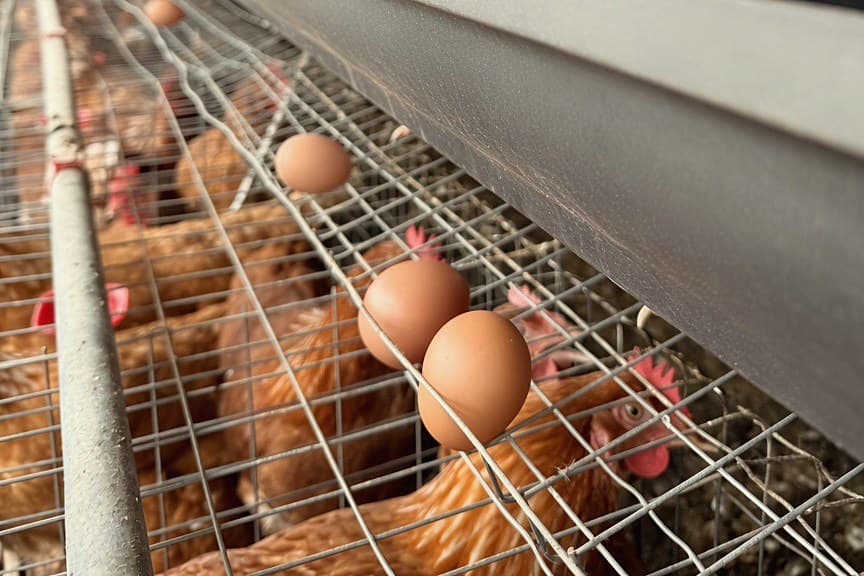
The most useful feedback we get does not come from a laboratory. It comes from the bakeries and distributors who buy our crates and use them the same week. They report the same three things: the yolk stands up rather than spreading, the white holds instead of running thin, and the shell breaks clean rather than shattering into the bowl.
Those are not mysterious qualities. Each one traces back to a specific decision about feed, housing, water, timing or handling — and each of those decisions is recorded daily on this farm. This is what sits behind them.
1. The shell is a calcium story, and most feed gets it wrong
A laying hen spends roughly two grams of calcium building a shell every single day, and she retains well under half of what she eats. A ration formulated for birds in lay carries 3.5 to 4.2 per cent calcium to cover that. A pullet developer — the feed a bird should be on before she starts laying — carries about one per cent.
That gap is the single most common reason a Nigerian crate arrives with thin shells and hairline cracks. It is also invisible on the bag: names like "layer grower" sit on rations of both kinds, and a farm can feed the wrong one for two months without the crate count dropping enough to notice.
The name on the bag is not evidence. Calcium is. It is the one figure that cannot be marketed around, and it is the first thing we read on any new feed.
- We read the printed analysis on every feed before it is fed, and record calcium, available phosphorus, lysine, methionine and energy against the bird's requirement — in grams per bird per day, not as a percentage compared to another percentage.
- Limestone or oyster-shell grit is offered separately in the afternoon, 3 to 5 grams a bird. Shell is laid down overnight, so calcium eaten late in the day is calcium available when the hen actually needs it.
- Feed issued and eggs collected are weighed daily, which is how a ration problem shows up here in days rather than in the following month's sales.
2. The house decides whether the egg ever needs washing
Our layers are in a three-tier cage system — twelve units, 96 birds each, with cup and nipple drinkers. The design matters for one reason above all others: the egg rolls forward onto the collection tray within seconds of being laid. It never touches litter, droppings, or the floor, and there is no open water for it to sit in.
Which means it does not need washing — and we do not wash it. Every egg comes sealed by the cuticle, a thin natural coating over roughly seven thousand pores in the shell. Washing strips it. A washed egg ages faster and is more open to bacteria than an unwashed one, which is precisely backwards from what most buyers assume.
A farm that lets its eggs get dirty has to wash them. A farm that keeps them clean does not. The housing decision comes first; everything else follows from it.
3. Water is the quiet half of feed
A laying bird drinks between two and a half and three times the weight of the feed she eats, and more than that in Rivers State heat. A bird that cannot drink will not eat — so a nipple line running slow does not look like a water problem. It looks like a smaller egg, two weeks later.
We check flow rate rather than assume it, and the site runs on a 10,000-litre reservoir with solar generation behind it, so the drinker line does not depend on the grid staying up. Uninterrupted water is unglamorous and it is one of the cheapest quality controls available to a layer farm.
4. A calm bird lays a better egg
Shell formation happens overnight, over a stretch of roughly fifteen hours. A hen disturbed during that window — by heat, by noise, by an unfamiliar person, by a break in routine — can produce a shell defect from that night alone. Stress is not an abstract welfare concern here; it is a physical interruption of a process already in progress.
- Staff live on site, so the birds are handled by the same people, at the same hours, every day.
- CCTV runs across the farm around the clock, which means a disturbance at 2am is something we can review rather than guess at.
- Routine is deliberately boring. Feeding, collection and inspection happen on a fixed rhythm, because the birds calibrate to it.
5. Yolk colour is a pigment fact, not a quality one
This is where we will say something against our own interest, because buyers are routinely sold on it. A deep orange yolk comes from xanthophylls — plant pigments in maize and other feed ingredients — passing into the yolk. A pale yolk usually means a cereal-heavy, low-pigment ration.
But colour can be dialled up with additives alone, and an egg with a deep yolk is not automatically a better egg. What the diet genuinely changes is what is in the yolk, not only what it looks like. So judge the yolk by whether it stands up in the pan and by how thick the white around it is — those track freshness and nutrition. Do not buy on colour, from us or from anybody.
6. Collected twice a day, never held past three days
Heat is what ages an egg, and an egg left in the cage is exposed to both heat and contact. Collecting twice daily rather than once shortens that exposure, cuts breakages, and means the crate you receive was gathered in one morning rather than accumulated over a day and a half.
- Stock is never held beyond three days. In Rivers State heat that is the real spoilage control; the store is secondary.
- Trays sit pointed-end down on raised pallets, off the floor, shaded and ventilated but out of a hot draught.
- Storage is kept well away from fuel, generator exhaust, kerosene, onions and agrochemicals. The shell is porous and an egg will take on the smell of whatever it is stored beside.
- Eggs are not moved between temperature extremes. Condensation on a cold shell in warm air is a route in for mould and Salmonella.
- Every crate that leaves our gate carries its collection date. Most crates sold in this market carry none.
7. Health, and the eggs that do not leave the gate
The flock runs on a standing vaccination and treatment schedule with due dates derived from the last dose given, not typed into a calendar and forgotten. Every treatment is recorded against the bird group that received it, with the withdrawal period its own label states.
Our sales system then refuses to release eggs from a flock under an active drug withdrawal. Not a policy in a folder — a refusal in software, on the form the sale is actually written on. For a bakery or a caterer buying at volume, that is the control worth asking any supplier about.
What we are not claiming
We have not had our eggs laboratory-tested against anyone else's, and we will not pretend otherwise. What we can tell you is which variables we control, how each one is measured, and that every figure above is written down daily rather than remembered.
When a baker tells us the whites hold better, the reasons are on this page. None of them are secret, and all of them are ordinary discipline applied consistently — which, in this market, turns out to be the rare part.
Table eggs are available by the crate and in bulk, graded by size, dated at collection. Ask us what any of the numbers above look like this week.